Gerry Marten

Ecologist, educator and author

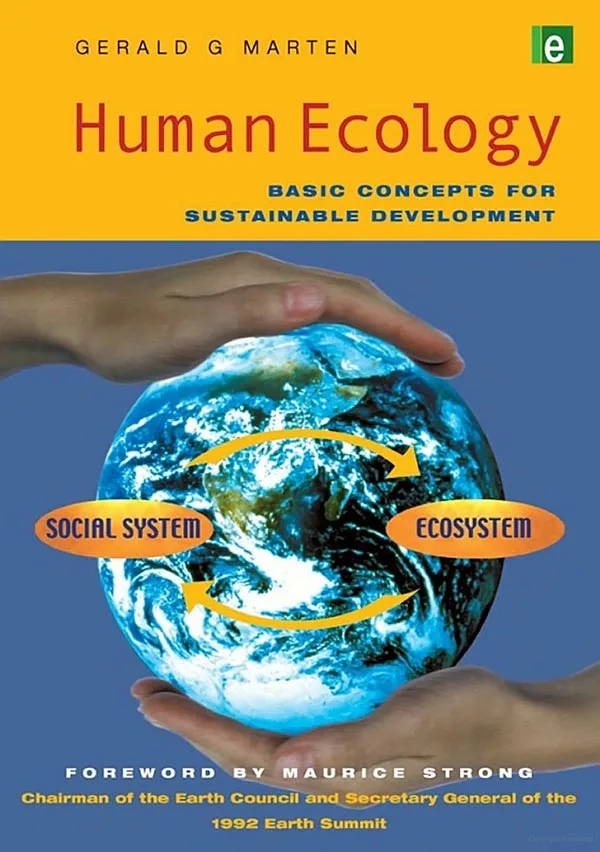
Human Ecology book cover

Human Ecology
Basic Concepts for Sustainable Development

  • Author: Gerald G. Marten
  • Publisher: Earthscan Publications (now part of Routledge)
  • Publication Date: November 2001, 256 pp.
  • Paperback ISBN: 1853837148
  • Hardback ISBN: 185383713X

Table of Contents

1. Introduction

This chapter introduces human ecology as the study of relationships between human social systems and the ecosystems on which they depend. It examines how materials, energy, and information move between society and the environment, and how human activities can produce complex chains of ecological and social consequences. Examples involving commercial fishing, deforestation, and pollution illustrate these interactions. The chapter also introduces sustainable development and explains how population, consumption, and technology influence the intensity and sustainability of human demands on ecosystems.

Chapter contents:

2. Populations and feedback systems

This chapter explores how positive and negative feedback shape populations, ecosystems, and human social systems. Exponential population growth demonstrates how positive feedback can produce rapid and sometimes unexpected change, while negative feedback regulates populations within limits imposed by resources and other environmental conditions. Examples such as water hyacinth and animal populations illustrate how feedback loops create growth, decline, stability, and instability. These concepts provide a foundation for understanding population regulation, environmental change, and the dynamics of human–ecosystem interactions.

Chapter contents:

3. Human population

This chapter traces human population history from hunter-gatherer societies through the Agricultural and Industrial Revolutions to the modern population explosion. It examines how agriculture, technology, public health, and changing social conditions altered the environmental limits that historically regulated human numbers. The chapter also considers social mechanisms of population regulation and the relationship between population growth and quality of life. By placing recent rapid growth in historical and ecological context, it explores the consequences of increasing human demands on ecosystems and the implications for the future.

Chapter contents:

4. Ecosystems and social systems as complex adaptive systems

This chapter examines ecosystems and human social systems as complex adaptive systems composed of many interconnected parts. It introduces emergent properties—characteristics that arise from the organization and interactions of a system rather than from individual components alone. The chapter explores hierarchical organization, self-organization, stability domains, and recurring complex-system cycles to explain how ecosystems and societies respond and adapt to change. These concepts provide a framework for understanding the often unpredictable dynamics of human–ecosystem interactions and for recognizing patterns important to sustainable development.

Chapter contents:

5. Ecosystem organization

This chapter explains how self-organizing ecological processes create complex, functional ecosystems. It examines coadaptation among plants, animals, and microorganisms; the organization of biological communities into food webs; and the processes that contribute to ecosystem homeostasis. Natural, agricultural, and urban ecosystems are compared in terms of their organization, inputs, outputs, and dependence on human management. The chapter also explores landscape mosaics, showing how interconnected patches of ecosystems reflect variations in topography and physical conditions while functioning together as parts of a larger ecological system.

Chapter contents:

6. Ecological succession

This chapter examines ecological succession, the gradual and systematic change in biological communities over time. It explains how natural succession reshapes ecosystems and how human activities can initiate unintended and sometimes irreversible changes. Examples including overgrazing, overfishing, and forest-fire management demonstrate the practical consequences of human-induced succession. The chapter also explores ways people can manage ecosystems by working with natural processes rather than against them, including traditional approaches to agriculture and forest management that use ecological succession while requiring fewer human inputs.

Chapter contents:

7. Coevolution and coadaptation of human social systems and ecosystems

This chapter explores coevolution and coadaptation—the processes by which human social systems and ecosystems change together and adjust to one another. Just as species evolve in response to other organisms, human societies adapt to their environments while simultaneously altering those environments. Examples from traditional social systems illustrate how long-term interaction can produce practices well adapted to local ecosystems. The chapter also examines the transformation from traditional to modern agriculture, showing how technological and social change can reshape the continuing relationship between societies and the ecosystems that support them.

Chapter contents:

8. Ecosystem services

This chapter examines the ecosystem services that provide people with food, water, natural resources, waste processing, and other necessities of life. It explains how material cycling and energy flow allow ecosystems to continually renew many resources and how healthy biological communities sustain these processes. The chapter explores how increasing population, consumption, and resource use can overwhelm ecosystem capacity, causing services to decline or disappear. It also challenges the assumption that economic supply and demand alone can prevent overexploitation of renewable natural resources.

Chapter contents:

9. Perceptions of nature

This chapter explores how individual and cultural perceptions of nature shape decisions about ecosystems and the environment. People interpret the world through mental images and stories that collectively form a worldview, influencing how they understand ecological change and respond to environmental problems. The chapter examines several common perceptions of nature, including views of ecosystems as fragile, durable, capricious, or interconnected, and considers religious attitudes toward the natural world. It also cautions against romanticizing nature or traditional societies when evaluating human–ecosystem relationships.

Chapter contents:

10. Unsustainable human–ecosystem interaction

This chapter examines why relationships between human societies and ecosystems become unsustainable. It shows how migration, new technologies, economic institutions, population growth, urbanization, and expanding consumption can disrupt coadaptation and place excessive demands on ecosystems. Topics include the tragedy of the commons, intensive agricultural and urban inputs, exploitation driven by portable capital, and the rise and fall of complex societies. Drawing lessons from past and present environmental problems, the chapter emphasizes the risks of wishful thinking and the importance of the precautionary principle.

Chapter contents:

11. Sustainable human–ecosystem interaction

This chapter identifies principles for creating sustainable relationships between human societies and ecosystems. It emphasizes protecting essential ecosystem services, avoiding overexploitation, applying the precautionary principle, and designing technologies and human activities that work with natural processes. The chapter examines social institutions for sustainably managing common-property resources and ways urban ecosystems can coexist with nature. It also explores resilience and adaptive development, emphasizing the capacity of social and ecological systems to learn from experience, respond to changing conditions, and adjust continually in pursuit of sustainable development.

Chapter contents:

12. Examples of ecologically sustainable development

This chapter brings the book’s major concepts together through two real-world case studies of ecologically sustainable development. The first examines the use of copepods to control mosquitoes responsible for dengue hemorrhagic fever, demonstrating how ecological knowledge and community participation can support effective eco-technology. The second examines the Barataria-Terrebonne National Estuary Program as an example of regional environmental management. Both cases demonstrate how integrating ecological understanding with social realities can transform environmental problems into practical, locally grounded approaches to more sustainable human–ecosystem interaction.

Chapter contents:

Back to top